

The days of owning one or two bottom bracket tools to service the vast majority of modern bikes are now a distant memory. Press-fit introduced a wave of complexity and tooling to more premium bikes. And just as it looked like things were stabilising, in came the knight of T47 unknowingly on a horse with diarrhoea.
In 2015, Engin Cycles, White Industries, Argonaut Cycles, and Chris King sought to combine the easy serviceability of a threaded shell, but do it with the size benefits afforded by PF30 and similar 46 mm diameter press-fit shells. The result was T47, a 47x1mm thread that could be cut into existing metal bikes with 46 mm press-fit shells. Since then, the T47 standard has seen widespread uptake in the boutique bike world, along with mainstream brands such Trek, Factor and Felt.
While T47 sought to unify the previous mess that was bottom brackets, it has only worsened the required tool situation. From its early days, things started to get messy with various tool fitments and bottom bracket types, and nearly a decade later, it’s no cleaner.
This edition of Threaded is part rant, explainer, and solution provider. For anyone who’s fought with the paper-thin tool splines of a T47 Internal bottom bracket, this one is for you. Also, there’s some useful stuff here for anyone struggling with thin flange centerlock brake lockrings (looking at you, Zipp) or certain thread-together press-fit bottom brackets.
Who the hell made this mess?
The intention of T47 may have been great, but it didn’t take long for a lack of communication between manufacturers (largely on the component end) ruined it to the point that the 47 x 1 mm thread of T47 was the only consistent element to be found. It’s a multi-tiered mess, so let me pick through the layers.
Today there are wide and narrow format T47 bottom brackets. Frames with a shell width of 68 (road and gravel) or 73mm (MTB, and some gravel) are typically intended to have the bearing cups and the bearings external of the frame. The concept here is to replicate that of an English threaded bottom bracket, where the external cups add to the total bearing width that matches the length of a modern crankset spindle (86 mm for road and 92 mm for MTB). This is known as T47 External.
Then there are wide format T47 bottom bracket shells, where the bottom bracket bearing sits within the frame shell. Generally based on frame shell widths of 86.5 mm (road and gravel), 89.5 mm, or 92 mm (MTB), this is known as T47 Internal. Visually this is most similar to a press-fit system with the flange of the cup barely protruding past the frame.
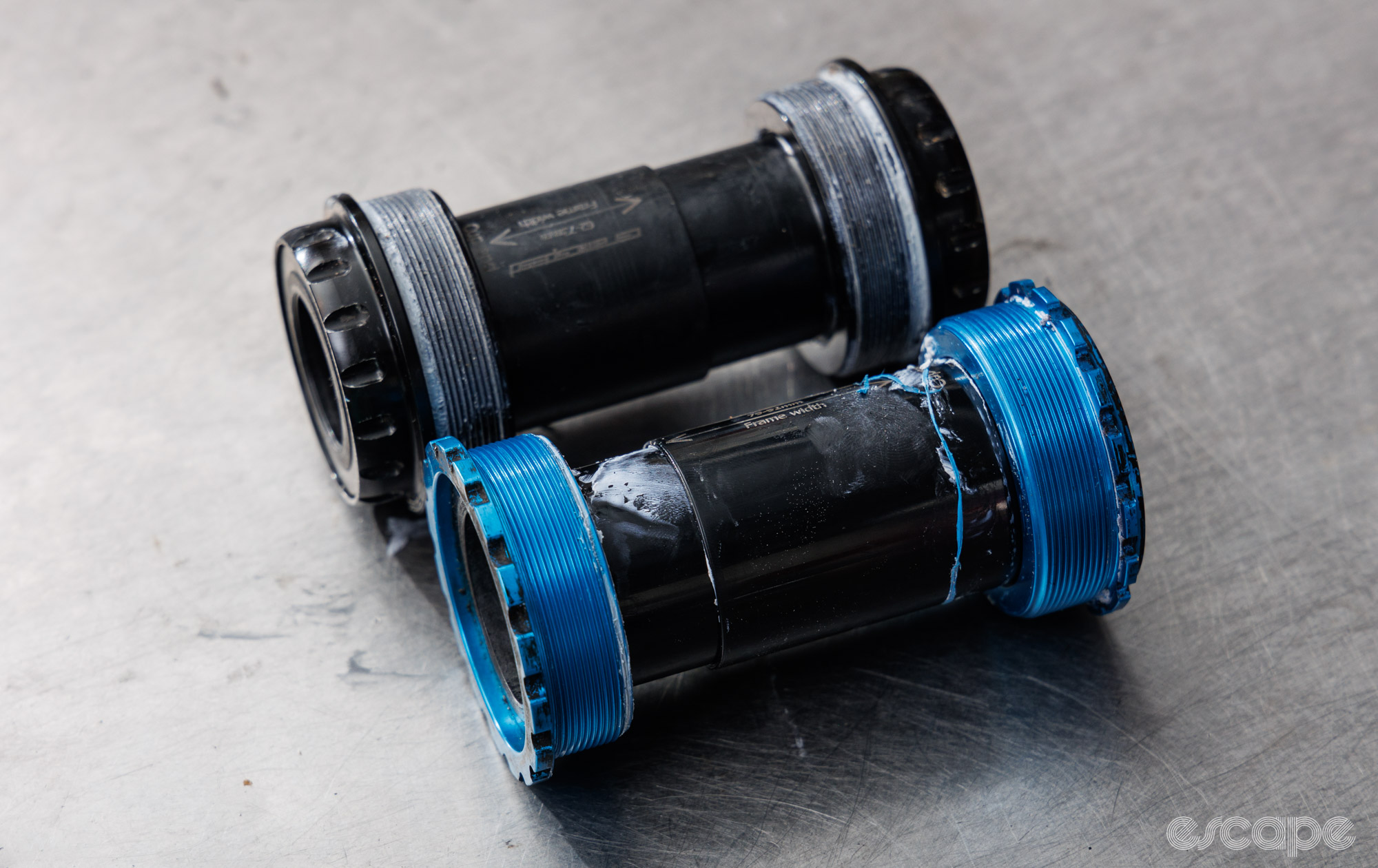
To make matters all the more confusing, there are the subtle iterations. Trek made its T47 shell widths 85.5 mm, 1 mm narrower than the usual T47 Internal concept (I’ll return to this). Meanwhile, Factor, Felt, and now Cervelo all have bikes that use an Asymmetric T47 (T47a), effectively a threaded version of Cervelo’s BBRight press-fit design. Here, the left-side cup is of a T47 Internal variant, while the right-side (drive side) cup is a T47 External. It’s funky but arguably hasn’t created wholly new products to fit.
Colnago’s T45 system, which lasted a mere two generations of road bikes, forced the creation of new products. It may have looked like T47, but at 2 mm smaller in diameter, it wasn’t. Colnago intended this to offer a replaceable (threaded) cup to receive a common BB86 press-fit bottom bracket. Obviously, having a press-fit cup within a threaded cup doubled the opportunity for creaks, and so soon enough, CeramicSpeed offered direct-fit T45 bottom brackets to try solve that pain. Either way, this system suffers many of the same woes as T47 Internal, which I’ll get to.
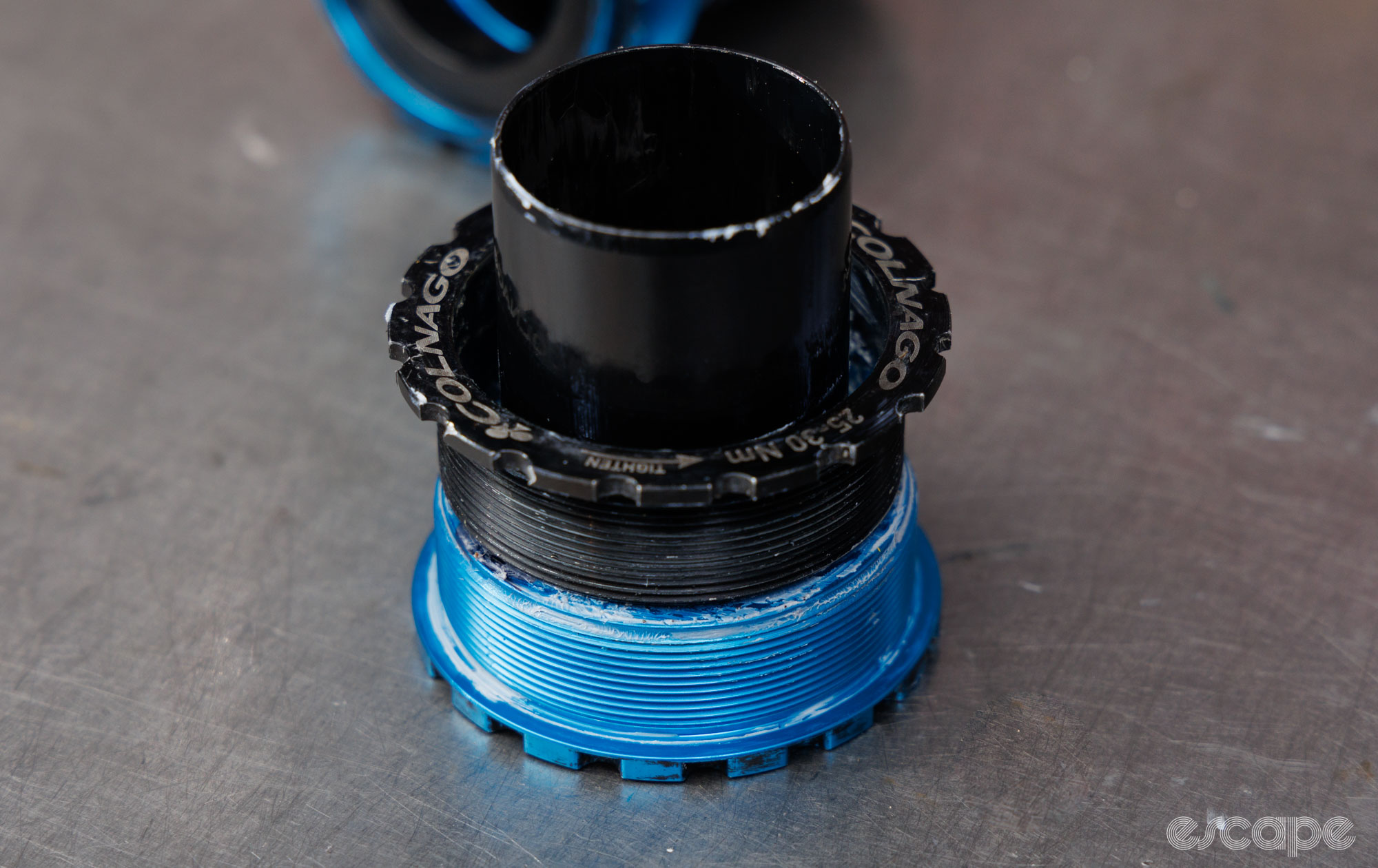
Already, things are looking confusing, and that’s before we even consider that there are three common crank spindle diameters (24, 28.99, and 30 mm), with a few weird ones on top of that. Sheesh!
If you’ve got your head around the number of variations in fitting a crank to a frame, allow me to introduce the biggest clusterf*ck of them all—tool fitment variations. That’s right, there’s no agreed-upon tool spline for T47, and by my count, there are approximately eight tool spline fitments that may be applicable.
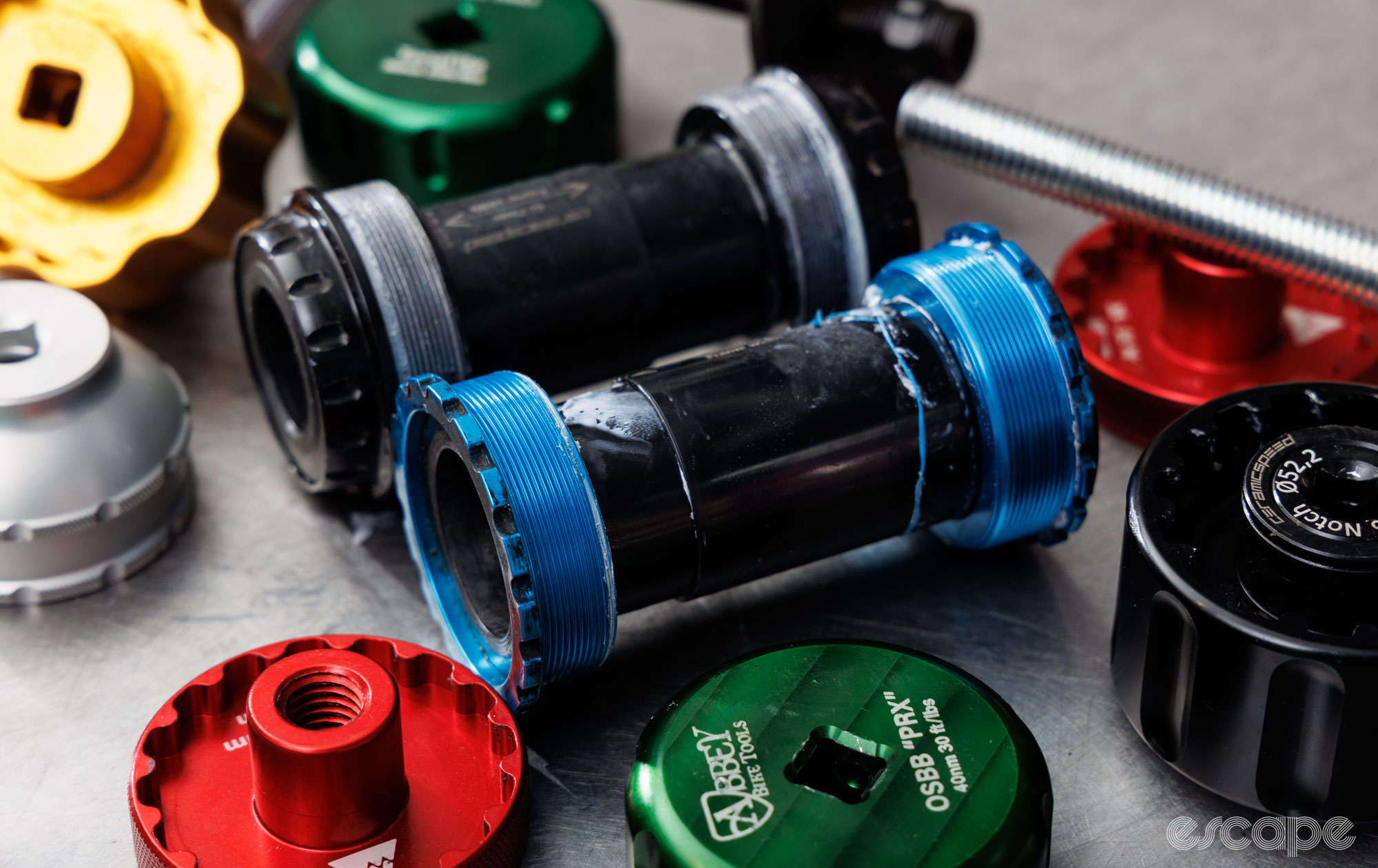
A drawer full of bottom bracket tools
Knowing which bottom bracket tool you need for T47 can be like seeking water with a divining rod. As overall diameter restrictions change, most bottom bracket makers will change the required tool between T47 External and T47 Internal options, with crank spindle diameter often playing a role, too.
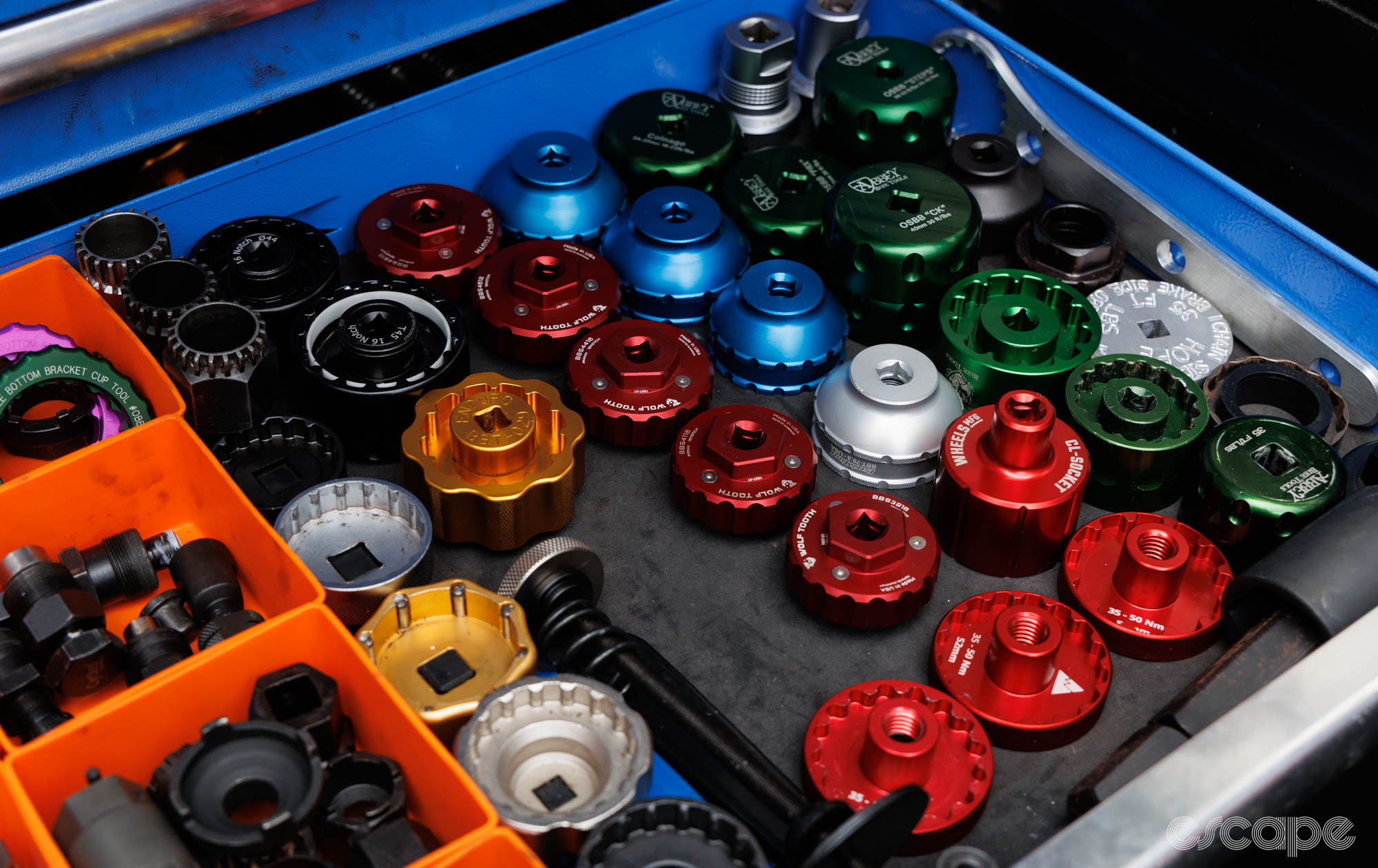
For example, T47 External bottom brackets typically offer a smaller diameter cup to fit a tool over and will therefore often use more widespread tooling. As a result, T47 External bottom brackets for use with Shimano 24 mm spindles often use the regular old 46.2 mm diameter and 16-notch tool, the same one you probably already own for use with many centerlock rotor lockrings, lower-end (or older) Shimano bottom brackets, and countless other external-type bottom brackets. Even where the crank spindle is a larger 28.99 or 30 mm in diameter, T47 External may use a size of tool shared with BSA30, DUB, or similar bottom brackets.
Did we do a good job with this story?