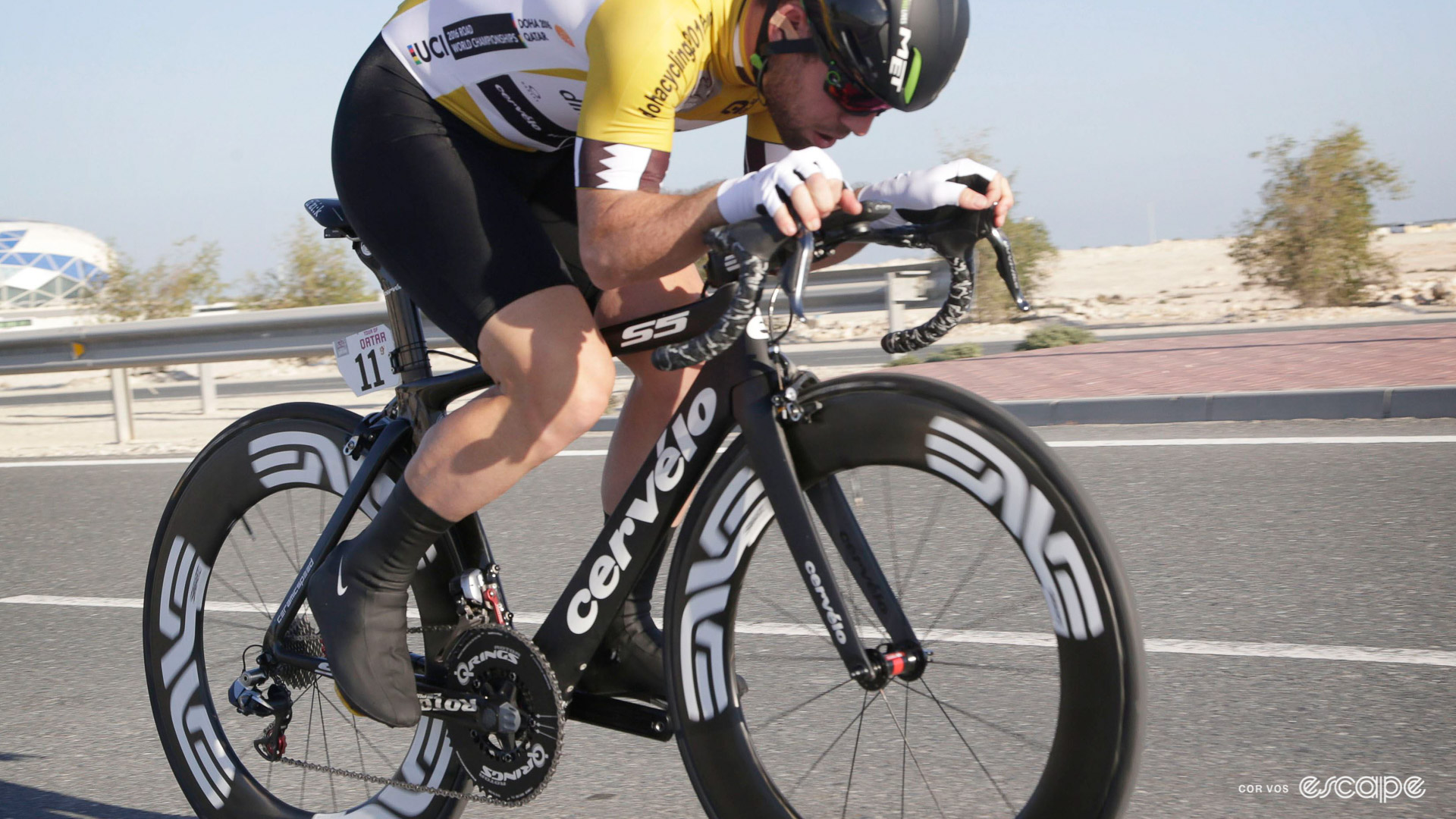


Why in 2023, when aero is everywhere, are the deepest and presumably most aerodynamic wheels all but disappearing from the pro peloton? It's not long ago that Zipp 808s were king for flat stages; heck, there once was a 1080 front and rear option. Fast forward to today, everything is aero, but save for the Victor Campenaerts of this world, the deep wheel seems like an endangered species.
That question floated around our internal "Geek Stuff" Slack channel during stage 11 of this year's Tour de France. Admittedly, with 1800+ meters of elevation gain that day, it wasn't exactly flat, but there were other stages with much less climbing, not to mention all the perfectly flat races we see elsewhere on the calendar, and yet we rarely see anything more than a 60 mm-deep rim. Surely, the aero gain from a deeper rim is even more at home on the already aero bikes in the modern peloton? Or do two aeros make a wrong?
We asked a few industry and WorldTour insiders for their opinion. Unfortunately, there's no simple answer; there isn't even a consensus, but a host of potential reasons why the deep wheel has fallen out of favour with riders, teams, and brands.
Common knowledge suggests deeper wheels are faster wheels, hence why the 80, 90, and 100 mm-deep rims still rule on time trial day. Everyone we spoke to confirmed as much, but the decision to ditch aero wheels for road stages seems much more nuanced and most due to the diminishing returns of deeper rims combined with the trade-offs in tyre integration, weight, and handling.
Tyre Width
Ah tyres, is there a better place to start? Probably, but anyway ... some of those we spoke to suggest the 80mm deep rims have fallen behind as the peloton trends toward wider tyres. As almost every rider and team is now using 28 mm or wider tyres, modern rims are trending wider to match. The "Rule of 105" was discovered and coined by Silca's Josh Poertner during his days at Zipp and states that the rim must be at least 105% the width of the tyre in order to re-attach the airflow from the tyre. In other words, the aero rim can't do its job in smoothing out the airflow if it is hiding behind a wider tyre. When the rim is wider than the tyre, roughly to the tune of 105%, it can capture the turbulent airflow coming off the tyre and smooth it out across the nice, smooth aero rim profile. Turbulent air = slow; smooth airflow = fast.
Did we do a good job with this story?