
One really shouldn’t mix a bike review and politics, but bear with me one second because I’ve good reason to do so with this bike.
Why, you ask? Well, because this is the new Factor One, the bike manufacturer's attempt at making the fastest bike possible under UCI rules. But many – probably myself included – have described it as "radical" since it first broke cover at the Critérium du Dauphiné back in June.
But as I sat down to write this review, I found myself questioning what is radical? One definition I found is supporting or favouring extreme social, political, or economic change, or being very different from the usual. Brace yourself, this is where it gets political.
You see, I happened to hear some political commentary recently discussing how the political parties and politics we may think of as radical are actually centrists, because, for better or worse, they do or say what the majority of voters want to see or hear right now.
Meanwhile, traditionally centrist parties are, they argued, actually the radicals because they, for better or worse, stick to tried-and-tested politics, which is increasingly what voters do not want to see. At the heart of the argument was the idea that a radical position is one that’s far away from the majority, and that the party delivering on what the majority want therefore can’t be radical, even if that’s how their politics are traditionally seen.
Look, I’m not actually going to go all political here, but I couldn’t help but think of the Factor One as I listened to this discussion.
On first glance, the One looks as radical as bikes come. Huge aero profiles, wide-stance fork legs, gull-wing handlebar, a bayonet nose cone merging into a fork crown that looks like it’s designed to mimic a horse saddle, and a silhouette that flirts with UCI non-compliance like a cat twists round your ankle … it has all the visual markers of a bike built to provoke and it’s a dedicated all-out aero rig in every way possible. It’s what the Venge might be, if Specialized would only answer the internet demands to resurrect its aero platform. And lord knows how I, and plenty others, want to see more full-on aero rigs. But if that’s what aero bike fans want to see, how can it be radical?
But if this bike is radical, those visible bits aren’t the real story, but merely the superficial radical. The One's truest radical nature is in its geometry.
Highs: Geometry that actually supports modern fits. Noticeable sail effect. High-speed straight-line stability. Huge toe clearance. Two fork offsets make for consistent trail figures across the size range.
Lows: Low-speed handling characteristics. Single bolt saddle clamp. The tops ain't for riding in. Peak fun may be the trade-off for peak performance. Holy moly, that pricing!
Price: Frame module (Premium Package) - US$6,899 / £6,899 / AU$10,599 / €6,599
SRAM RED AXS w/ Power Meter as reviewed - US$12,899 / £12,899 / AU$19,899 / €12,399
Shimano Ultegra, BI 62 wheels - US$ 10,899 / £10,899 / AU$ 16,799 / € 10,499
Shimano Dura-Ace, BI 62 wheels - US$ 12,599 / £12,599 / AU$ 19,399 / € 12,099
SRAM Force w/ power meter, BI 62 wheels - US$ 11,099 / £11,099 / AU$ 17,099 / € 10,699
Campagnolo Super Record 13, BI 62 wheels -US$ 13,199 / £TBC / AU$ 20,299 / € 12,699
The One targets what many have coined a “progressive road geometry,” as discussed on Escape podcasts over the past two years or so. The One follows that idea, and is designed to accommodate the positions Factor says (and which anyone can see) riders are already adopting: forward saddles, shorter cranks, narrower bars, longer stems, steeper effective seat tube angles, and increased reach. Comparing this to your existing geometry is going to lead to plenty of head scratching, but, again, if it’s merely facilitating what the performance-minded are doing … can it be radical?
Riders, myself included, know how difficult it can be to achieve an optimal position with traditional reach numbers. Think: how many saddles do you see slammed all the way forward these days? Stems in 140 and 150 mm lengths used to be radical, but are pretty commonplace these days as riders increasingly turn to 160 mm and longer.
 Ronan Mc Laughlin
Factor has targeted a geometry that better facilitates these positions, without requiring rudder-length stems. Factor’s argument is that these hacks to accommodate a modern position on a more regular geometry are unsafe as they shift the rider’s centre of gravity forward over the front wheel.
So who’s the radical one then? The One geometry that meets the modern rider where they are or where they want to be, or the more “normal” traditional geometry forcing riders to find workarounds to achieve the fit that modern racing increasingly demands? This isn’t radical geometry. This is modern, centrist geometry and what many are crying out for. But does it work? Is there a reason other manufacturers haven’t ventured here?
It’s not as if other brands are blind to the trend. Half the WorldTour has released new aero bikes in the last 18 months, and every fitter in the world will tell you saddles are coming forward, and riders are stretching out. WorldTour aside, customers are crying out for dedicated aero rigs. Yet only the One tackles these demands head-on.
So what gives? Are Factor simply listening better, and everyone else is stuck with their heads in the sand? Or are the lurings of a bike that answers aero-weenie prayers a trap others have sensibly avoided? I went to Girona in September for the launch and spent the last three weeks riding the new One at home to find out.
Let's back up a moment. What is this bike anyway, and why does it exist when Factor already has aero-minded bikes like the Ostro VAM? Simple: It’s Factor’s attempt at the dedicated aero bike with the goal of building the fastest UCI-legal bike on the market.
It’s not a do-it-all bike. Not a lightweight. And not built for comfort. In fact, it’s unapologetically the opposite. Perhaps it would have been easier to start with what the One isn’t, but long story short, it’s everything Factor knows about aero in 2025, condensed into one bike with the goal of making the fastest bike and rider system possible under current UCI rules.
In other words, the One exists because Factor believed there was still space – both in the market and within the rules – to make something meaningfully faster than the existing crop of aero bikes by tackling both the roughly 20% of total system drag that comes from the bike and better accommodating the human on top that accounts for roughly 80% of drag. Whether they’ve succeeded is something the rest of this review will dig into, but the intention couldn’t have been clearer.

A 22% faster 20%
If the objective was to build the fastest UCI-legal road frame, the route Factor chose to get there was largely focused on the front end of the bike. The result is practically a checklist of aero features: a bayonet fork, gull-wing bars, wide-stance fork legs, and impossibly narrow frontal area all combine as part of the One’s disappearing-from-the-wind act.
Despite some concern earlier this year that the One could be banned before it even entered production, it was actually a relaxation in the UCI rules that made it possible. While most brands, with a few exceptions, have iterated more conservatively within the new limits, the new One is the visual manifestation of what's possible under those new rules. When the UCI relaxed its rules, Factor’s head of engineering, Graham Shrive, saw an open corridor right to the edge of legality and took it.
The change to the fork conformity box constraints, which previously required the entire fork structure to sit within its own dedicated box with no overlap with the frame, created the biggest opportunity. Under the old regulations, the fork box and the down tube box could not intersect in any meaningful way. You couldn’t project the fork forward into the frame volume, and couldn’t overlap the fork and down tube without immediately running into dimensional non-compliance. The UCI's decision to relax those constraints meant there is now room to manoeuvre.
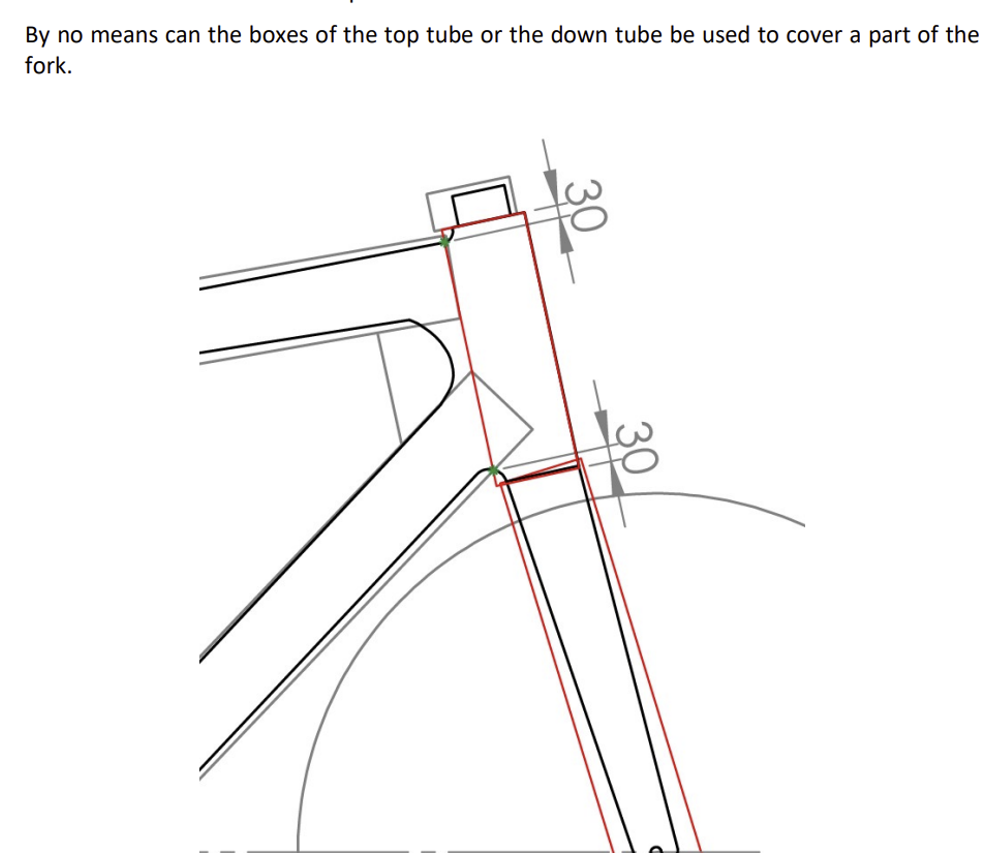
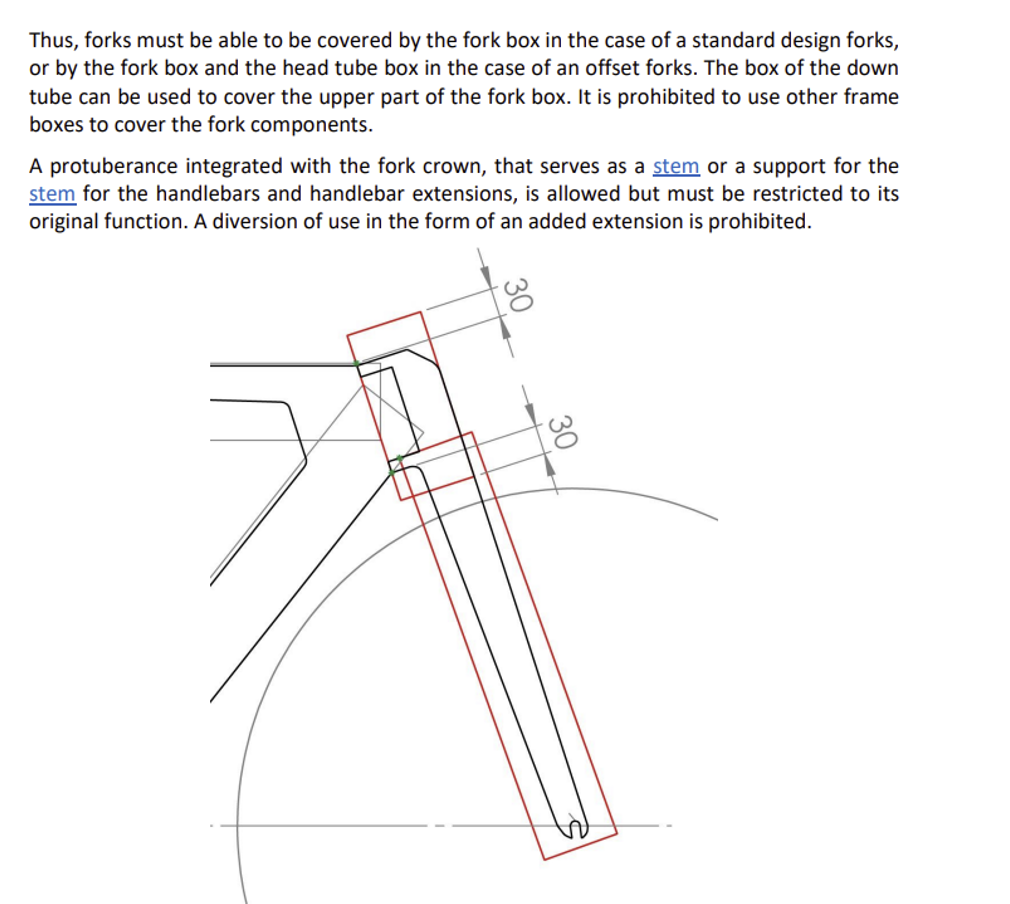
Old rules (left/above), new (right/below).
With the new rules, the down tube conformity box can legally overlap part of the fork’s box. That allows the fork to sit farther forward relative to the frame. And, in a somewhat hilarious twist, the UCI updated the leg-width rule again after Factor had already begun work on this design, restricting wider fork-leg spacing, but coincidentally or not, the new width limit now exactly matches the width of the One’s forks.
Shrive pointed to learnings from its Hanzo Time Trial and Hanzo Track development programmes, especially around tyre wake and how airflow “spills” off the leading edge of the wheel and “disrupts everything behind it,” as the trigger that made the fork-box change so potentially powerful.
Did we do a good job with this story?